 English
 中文版
Working Principle of Diesel Driven Split Case Pump
The diesel driven split case pump is an independent power pumping unit that does not require an external power supply. It uses a diesel engine as the power source and is equipped with a split-case double suction centrifugal pump. It is widely used in scenarios requiring large-flow water delivery, such as flood control and drainage, farmland irrigation, and emergency water supply.
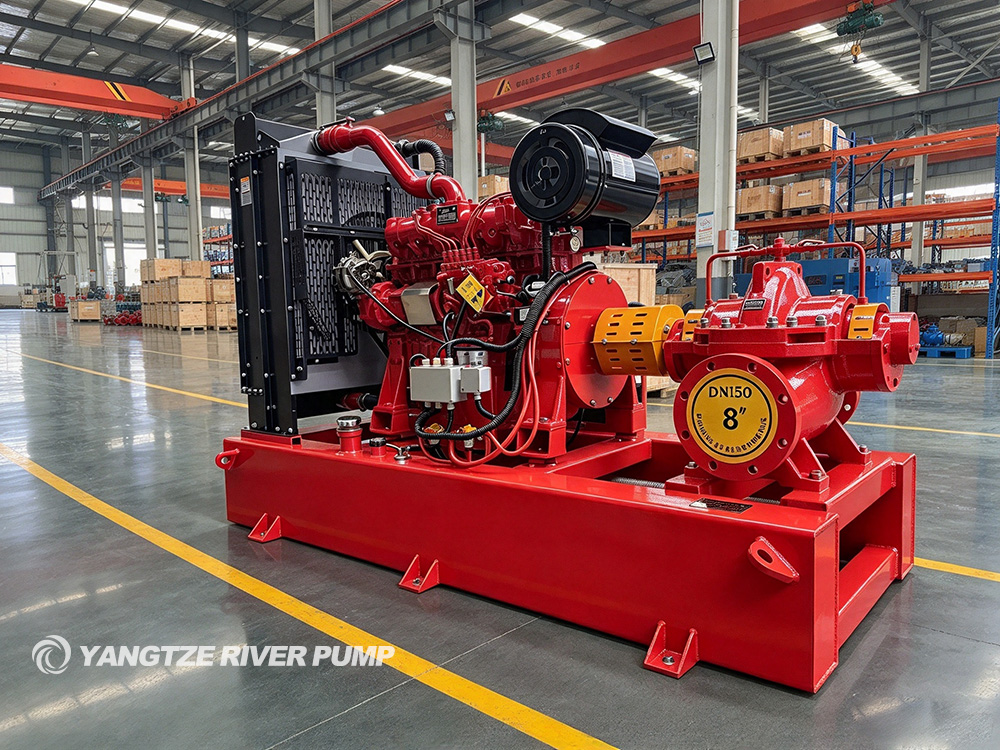
Diesel driven split case pump
Working Principle of Diesel Driven Split Case Pump
When the unit starts, the diesel engine burns diesel and converts the chemical energy of diesel into rotating mechanical energy. Power is transmitted to the pump shaft of the split case pump through a coupling or belt drive to drive the impeller to rotate at high speed. The impeller of the split case pump adopts a back-to-back symmetrical structure. After the pump is filled with water and air is vented before startup, liquid enters the impeller from the left and right suction ports simultaneously. The high-speed rotating impeller generates centrifugal force, throwing the liquid toward the outer edge of the impeller and increasing its flow velocity. The liquid then flows into the volute passage. As the cross-sectional area of the passage increases, the flow velocity drops, and kinetic energy is converted into pressure energy, forming high-pressure water that is discharged from the outlet. Since liquid is sucked symmetrically from both sides of the impeller, the generated axial forces counteract each other. This results in low vibration during operation and low bearing load. Compared with single-suction pumps, the double-suction structure features a larger flow area and better anti-cavitation performance, making it suitable for continuous medium delivery under large-flow working conditions.
Essence: The diesel engine outputs mechanical energy by burning diesel to drive the split case pump, which transports liquid by centrifugal force. It is an independent pumping unit for sites without power supply.
Core Hydraulic Transportation Principle of Split Case Pump
1. The pump must be filled with water and air must be exhausted before startup.
2. The impeller is of back-to-back symmetrical structure, and liquid is sucked in from both the left and right sides of the impeller at the same time.
3. The impeller rotates at high speed, driving the liquid to rotate. Under centrifugal force, the liquid is thrown to the outer edge of the impeller.
4. A low-pressure zone is formed at the center of the impeller. Atmospheric pressure continuously pushes water from the inlet pipe into the pump for continuous liquid supply.
5. The high-pressure liquid enters the volute pump body. The flow passage expands, the flow velocity decreases, kinetic energy converts into pressure energy, and the liquid is delivered from the outlet.
6. The biggest advantage of split case design: the axial forces generated by water inflow on both sides cancel each other out. The axial force is automatically balanced with low vibration, long bearing service life and good anti-cavitation performance. With the same impeller diameter, its flow rate is nearly twice that of a single-suction pump.
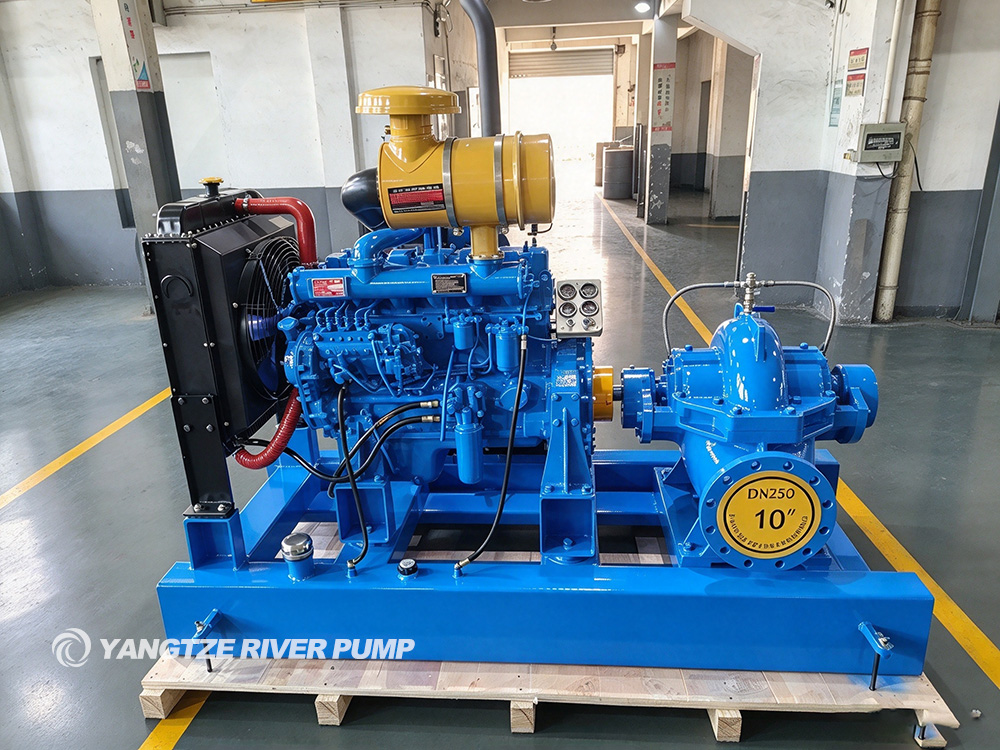
Energy conversion path: Chemical energy of diesel → Mechanical energy of diesel engine → Rotational mechanical energy of pump shaft → Pressure energy and kinetic energy of liquid. It realizes large-flow transportation for water supply, drainage, irrigation, fire fighting and other applications. In short, the diesel engine drives the double suction impeller to rotate. Water enters from both sides of the impeller, is thrown into the volute by centrifugal force for pressure rise and then discharged. Symmetrical water intake counteracts axial thrust for stable operation and large flow capacity.

