English
 中文版
Common Causes and Handling Methods for Centrifugal Pump Mechanical Seal Failures
Mechanical seals are the core component for preventing the leakage of the medium in centrifugal pumps, and they are also the parts with the highest failure rate in the pump assembly. Once the mechanical seal fails, the medium will leak, contaminate the site, and in severe cases, cause the pump to dry out and wear out. The following outlines the common damage forms, the corresponding causes, and the handling solutions.
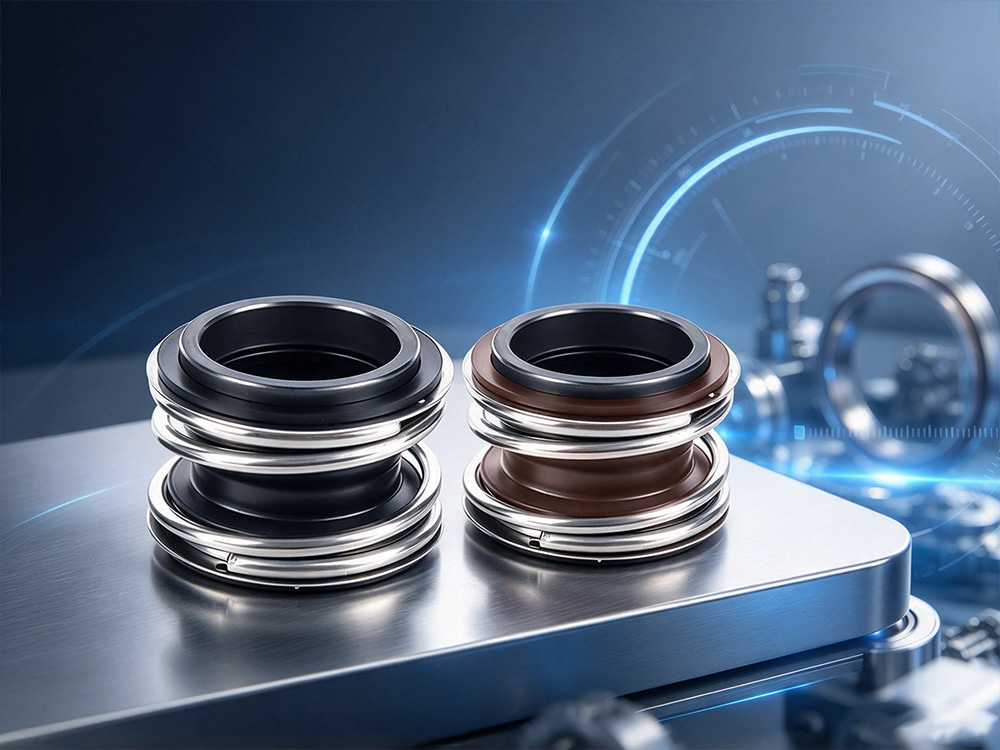
Common Causes and Handling Methods for Centrifugal Pump Mechanical Seal Failures
1. Dry grinding and burnout (blackening and cracking of the moving and static rings): The main cause is pump cavitation, suction loss, air entering the sealing chamber, interruption of flushing and cooling. The liquid film on the friction surface vaporizes and disappears, resulting in dry friction. Handling: Stop the pump, fully pump in and exhaust air, check for leakage points at the inlet, clear the flushing pipelines and filters, raise the inlet liquid level to ensure the cavitation margin, and use continuous cooling flushing in high-temperature conditions. Replace the mechanical seal after damage.
2. Particle wear (scratches and grooves on the end face): The medium contains solid impurities, which continuously cut into the friction pair of the moving and static rings. Handling: Install an inlet filter and clean it regularly, select carbonized silicon for the friction pair of the hard particle-containing medium, and use a self-flushing scheme such as Plan11. Replace the worn mechanical seal.
3. Seal ring failure (O-ring swelling, hardening, cracking): The seal ring material is not resistant to medium corrosion, is aged by excessive temperature, is scratched during assembly, or crystallizes and gets stuck due to low temperature. Handling: Select rubber materials (fluororubber, perfluoroether, etc.) based on the medium, control the temperature of the sealing chamber, ensure proper protection during assembly to avoid sharp edges from cutting, and add heating and regular flushing for crystallizing media.
4. Spring compensation failure (spring jamming, corrosion fracture): The medium deposits and crystallizes on the spring, the medium causes corrosion and pitting, the rotor has large axial movement, or the installation compression amount is incorrect. Handling: Select Hastelloy alloy springs for corrosive media, use isolation flushing for crystallizing conditions, correct the rotor's axial movement, and strictly control the spring compression amount according to the sample.
5. Single-sided uneven wear: Pump shaft bending, rotor imbalance, bearing damage, large misalignment of the coupling, misaligned installation of the seal cover, or misalignment. Handling: Correct the pump shaft or perform rotor dynamic balance, replace the failed bearing, realign the coupling, evenly tighten the bolts of the seal cover, and install the seal concentrically.
6. Leakage upon installation: Inappropriate installation compression amount,磕碰划伤 of the end face of the moving and static rings, failure to remove the positioning clamp, scratches on the shaft sleeve from the seal, or contamination of the assembly environment. Handling: Adjust the compression amount according to the mechanical seal parameters, protect the friction end face throughout the process, remove the positioning clamp after installation, grind the shaft sleeve scratches, and keep the assembly clean.
7. Corrosion damage (pitting and rusting of metal parts): The medium is highly corrosive, such as acid, alkali, or chloride ions. The selected mechanical seal material is too low. Handling: Upgrade the mechanical seal material, select double-end face mechanical seals + isolation liquid system for strong corrosive conditions.
8. Pressure shock damage: Frequent start-stop operations and rapid opening and closing of valves cause pressure fluctuations, repeatedly disrupting the liquid film on the end face. Handling: Perform smooth start-stop operations, avoid rapid opening and closing of the outlet valve, and use anti-shock structure mechanical seals for high-impact conditions.