 English
 中文版
Detailed Explanation of Working Principle and Structural Characteristics of Submersible Sewage Pump
The submersible sewage pump is an integrated fluid conveying equipment with pump and motor combined, operating submerged below the liquid surface. It is widely used in municipal sewage pipe networks, basement drainage, chemical wastewater, construction site flood drainage, farms, residential sewage discharge and other scenarios. Different from traditional land-based water pumps, it works by submerging the whole unit into the medium, eliminating complex water diversion devices. Featuring convenient installation, small footprint and strong flood resistance, it serves as the core equipment for transporting sewage and media containing impurities. Below is a detailed illustration of its working principle, core structure and structural features.
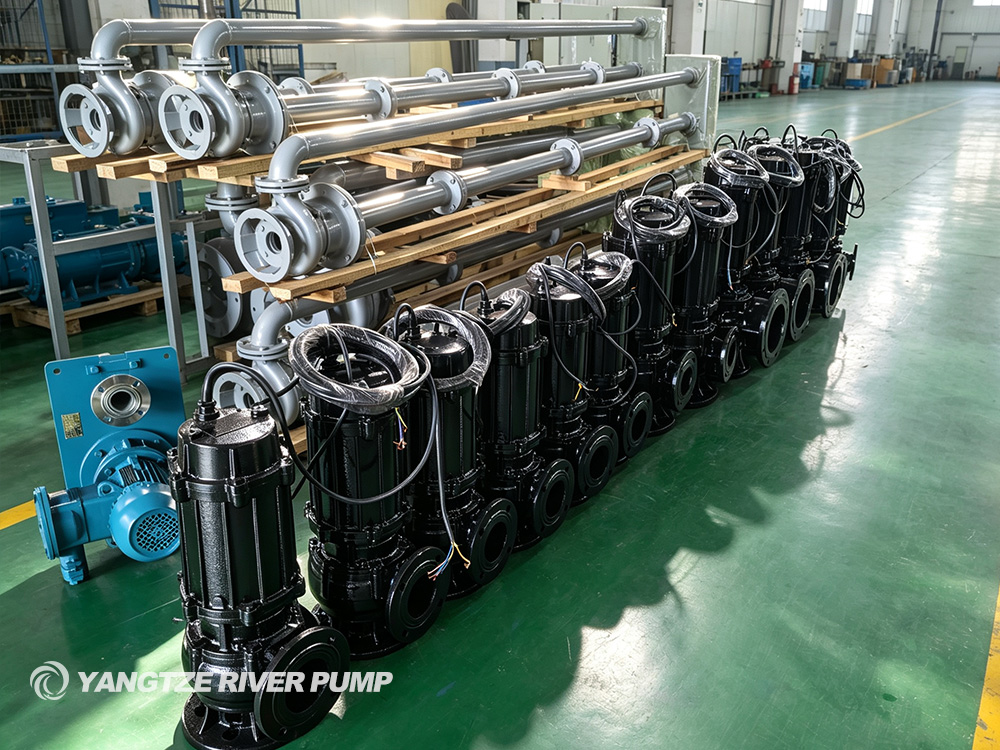
Submersible Sewage Pump
Submersible sewage pump working principle
The whole pump is immersed in sewage. After power-on, the built-in motor drives the impeller to rotate at high speed. The rotation of the impeller forms a negative pressure inside the pump chamber. Under atmospheric pressure, sewage together with suspended sludge, fibers and fine solid particles is sucked into the impeller flow channel through the water inlet at the bottom of the pump body. The medium gains kinetic energy and pressure energy in the impeller, then is boosted and guided by the volute (pump casing), and delivered to the designated discharge position along the outlet pipeline. For sewage with high winding tendency, cutting-type submersible sewage pumps are equipped with a cutting mechanism: a cutting blade set is installed at the water inlet. The impeller drives the cutter disc to rotate relative to the stationary blade, chopping cloth strips, plastic ropes, fibers and other sundries before feeding them into the pump for conveyance to avoid clogging. Ordinary non-cutting models adopt wide flow passage structures to allow smooth passage of particles. The motor and the pump share the same shaft. During operation, the motor is continuously cooled by the surrounding sewage without an extra air cooling system. The whole equipment runs underwater, and water blocks most of the operating noise.
Main Structural Components
1.Motor Assembly: Mostly dry-type or oil-filled submersible motors, consisting of stator, rotor, bearings, built-in thermal protection and water leakage detection probes. The sealing system is critical. Multiple mechanical seals are adopted to prevent sewage from penetrating into the motor cavity. The protection device will automatically shut down the pump in case of water seepage or overheating.
3.Hydraulic Components of Pump: Water inlet chamber, impeller, volute and outlet flange. The commonly used impellers include flow passage impellers, tearing impellers and cutting impellers, which are the key parts determining sewage discharge capacity and anti-clogging performance.
3.Cutting Mechanism (Optional): Moving and stationary blade assemblies, generally mounted at the water inlet, suitable for septic tanks and working conditions with abundant fibrous waste.
4.Sealing System: Primary mechanical seal, secondary seal and oil chamber. The lubricating oil in the oil chamber lubricates the seal end faces, dissipates heat and isolates the conveyed medium.
5.Auxiliary Parts: Waterproof submersible power cable, automatic coupling device, float level switch, guide rail and lifting chain. The coupling device facilitates hoisting and maintenance, while the float switch realizes automatic start-stop based on water level.
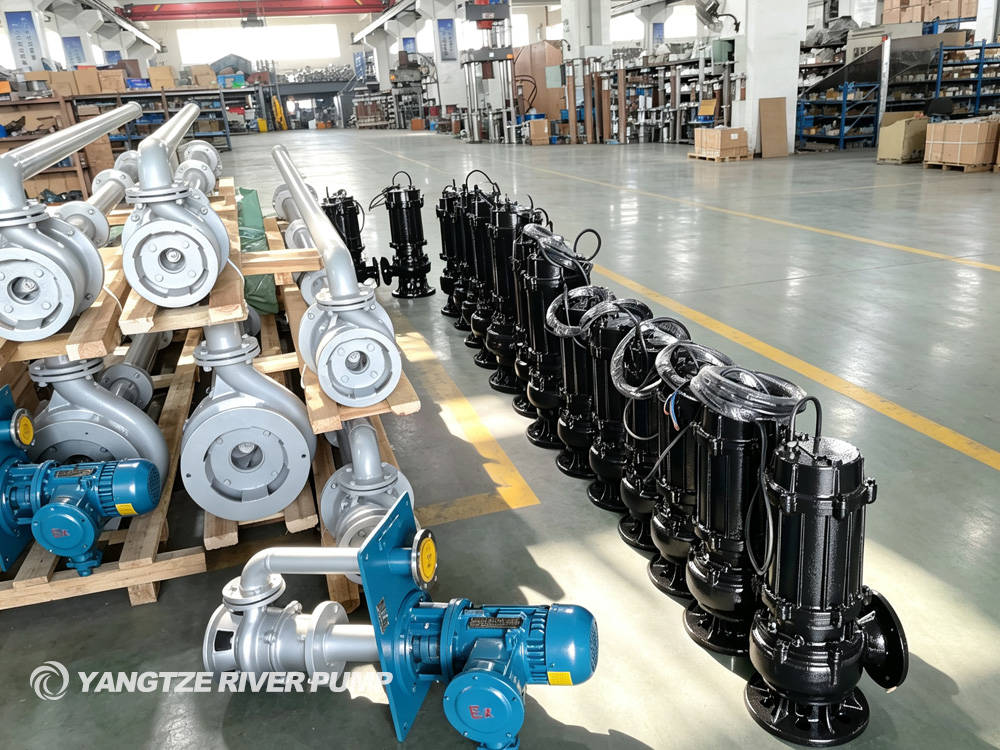
Submersible Sewage Pump
Structural Characteristics
1.Integrated design for underwater installation: The pump and motor are tightly combined as one unit and can be directly submerged in water. No pump house construction is required, which reduces civil engineering costs and saves space. It can be fixedly installed with a coupling system or used movably for temporary flood drainage.
2.Multi-stage sealing for reliable waterproof performance: Independent oil chambers plus double-face mechanical seals are adopted. Some models are equipped with water leakage and overheating protection to prevent sewage from invading the motor for long-term continuous underwater operation.
3.Anti-clogging design for sewage media: Two options are available: large-channel non-clogging impellers and cutting structures, capable of transporting sewage containing solid particles, fibers and silt and reducing winding and pump jamming failures.
4.Self-cooling and low noise: The motor is cooled by the surrounding conveying medium with stable heat dissipation conditions. Water absorbs vibration and noise, resulting in low noise on the ground, making it suitable for residential areas and basements.
5.High adaptability for automation: It can be matched with float switches or level transmitters to realize automatic start and stop according to water level for unattended operation. With supporting coupling guide rails, the pump can separate from the base along the guide rails during maintenance without disassembly inside the tank.
6.Wide range of applicable media: With proper model selection, it can transport domestic sewage and mildly corrosive industrial wastewater. Materials such as cast iron and stainless steel are optional to meet different anti-corrosion requirements.
Meanwhile, its integrated structure also brings limitations: immersed in sewage for a long time, sealing parts are consumables requiring regular inspection and maintenance. Large hard impurities in the medium may still cause impeller damage and pump stalling.
Summary
In short, the submersible sewage pump realizes sewage suction and delivery through the pressure difference generated by impeller rotation. It integrates the motor, hydraulic components, sealing and protection systems to operate submerged in the medium. Its core advantages lie in the integrated layout, reliable underwater sealing and targeted anti-clogging structure. When cooperating with automatic control assemblies, it achieves simple and efficient sewage transportation. During application, users should select either ordinary large-flow models or cutting models according to impurity conditions of the medium. Regular maintenance of mechanical seals and cables can give full play to equipment performance, reduce failure rates and complete stable drainage and sewage discharge.

