 English
 中文版
WQ Submersible Sewage Pump Selection Guide
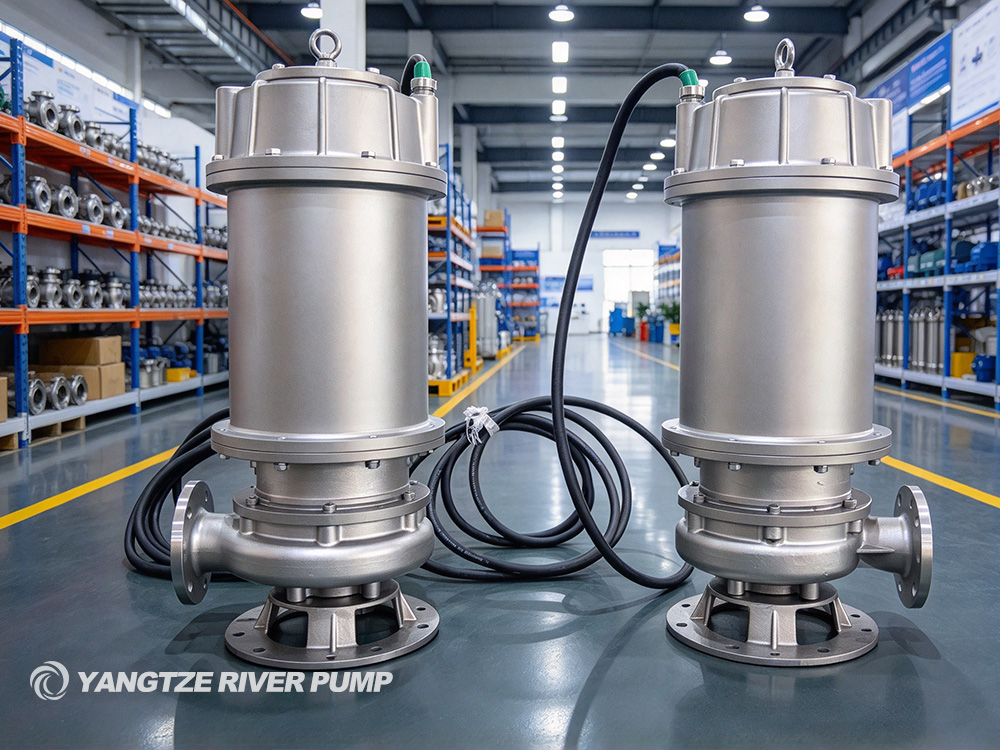
WQ submersible sewage pumps are widely used in municipal sewage, construction site drainage, industrial wastewater, basement sump drainage and other scenarios. The core of pump selection is to confirm the required flow rate, calculate the actual total head and select proper wetted parts materials. All three parameters are essential. Mismatched parameters will easily lead to no water output, motor overload burnout, rapid corrosion and wear.
WQ Submersible Sewage Pump Selection Guide
1. Flow Rate Calculation
Flow rate means the volume of sewage delivered per unit time, commonly in m³/h.
1. Sump drainage:Q=V/T
V = effective volume of sump tank (m³); T = allowable drainage time (normally 5~15 min, smaller value for large sewage flow)
Example: Effective sump volume 10m³, to drain within 10 min, \(Q=10÷(10/60)=60\mathrm{m^3/h}\)Continuous drainage: adopt the maximum actual sewage output, with 10%~20% margin. For parallel multiple pumps, distribute peak flow to single pump.
Selection rule: rated pump flow ≥ calculated maximum sewage flow. Avoid excessive flow to prevent frequent start-stop.
2. Total Head Calculation (Most error-prone)
Total Head H{total}= H{vertical}+H{pipe loss}+H{outlet margin}
H{vertical}: geometric lift height, vertical distance from lowest liquid level to outlet center (m)
H{pipe loss}: friction loss of pipeline + local loss from elbows, valves and reducers. Loss rises with smaller pipe diameter, longer pipeline and more elbows. Estimation: about 0.5~1m loss per 10m straight pipe; one 90° elbow equals 0.5~1m loss.
H{outlet margin}: normally reserve 2~3m to guarantee sufficient outlet velocity.
Key point: Do NOT only use vertical height while ignoring pipe loss. Selection rule: pump rated head ≥ calculated total head. Overrated head will cause excess flow and motor overload.
3. Material Selection (Depends on medium)
Common WQ materials: cast iron, SS304, SS316L.
1.Domestic sewage, rainwater, non-corrosive construction wastewater:cast iron WQ, cost-effective, solid particle ≤10mm.
2.Mildly corrosive wastewater (kitchen wastewater, weak acid & weak base):304 stainless steel wetted parts.
3.Chemical wastewater, saline water, chloride-containing medium:316L stainless steel, resistant to chloride corrosion.
4.Extra notes: sewage with long fibers (cloth, plastic strips): cutting-type WQ with cutter. Sewage with lots of sand: thickened wear-resistant cast iron.
4. Auxiliary parameter verification
1.Medium temperature: standard WQ ≤40℃; customized submersible motor for hot sewage.
2.Solid particle size: must be smaller than pump passage diameter.
3.Motor power: match power according to pump performance curve after confirming flow and head. Never use low-power pump for heavy duty.
4.Accessories: submersible power cable, float level switch for automatic start & stop.
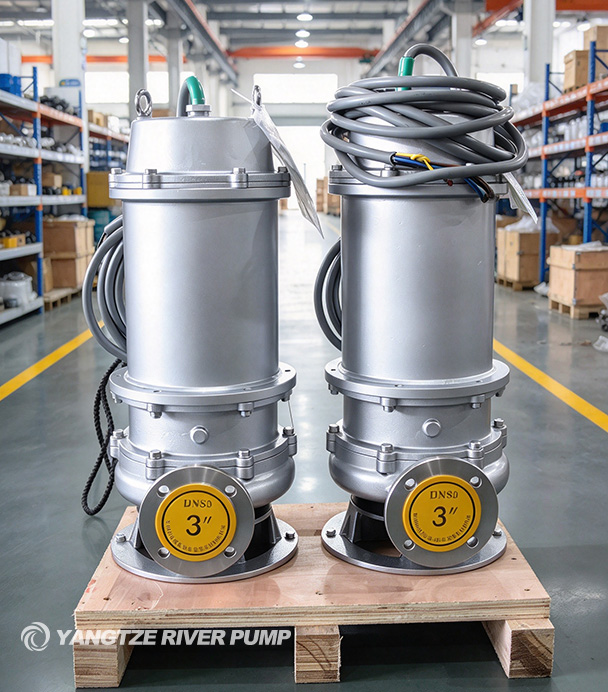
Three-step selection for WQ submersible sewage pump: ① Calculate maximum sewage flow with safety margin; ② Compute total head by adding vertical lift and pipeline resistance; ③ Select pump material based on sewage corrosivity and impurities. Verify medium temperature and particle size, refer to pump performance curve. Do not select pump only by vertical lift. Proper parameter matching ensures stable long-term operation and reduces breakdowns.

